Showing posts with label environmental law. Show all posts

Monday, October 17, 2022

Free/Reduced Fee Sporting Licenses for Senior Citizens Offered

A 2014 survey carried out by the Oulu Deaconess Institute found that hunters and fishers feel that their physical, social and mental well-being is enhanced by spending time outdoors. These activities benefit our economy, provide funding for conservation and wildlife management and directly connect us with life on our planet.

With this in mind, New York State offers free or reduced fee sporting license/privileges for a number of groups, including the following:

• Active-duty military members
• Military veterans with 40% or more service-related disability
• Juniors (15 and under)
• Persons with Disability
• Native American members of select tribes
• Full-time nonresident students attending a New York College/University
• Seniors (ages 70+)

The requirements vary by category. For senior citizens, 70 years and older who are New York State residents, they are eligible for the following:

• $5 each fishing, hunting and trapping licenses
• Free bowhunting and muzzeloading privileges ($5 base hunting license is required)

In order to qualify, the required documents/proof are:

• For hunting licenses/privileges or trapping license: an appropriate hunter education program certificate or previous license/privilege;
• Proof of NYS residency.

Eligible Schuyler County seniors can get their reduced-fee licenses at the Schuyler County Clerk’s Office, 105 Ninth Street, Watkins Glen, New York, as well as at several town offices and businesses throughout the county. A complete list of approved locations can be found at the New York State Department of Environmental Conservation website.

Hunting and fishing in Schuyler County and New York State offer a wealth of outdoor recreational opportunities. Purchasing a free or reduced fee license for these activities is an excellent way for seniors to support New York's wildlife management efforts and remain active in our great outdoors.

Monday, June 7, 2021

Second Amendment Legal Update: June, 2021

A monthly update, prepared for the Schuyler County Chapter of S.C.O.P.E. NY, a statewide 501(c)4 organization dedicated to preserving the 2nd Amendment rights for the residents of New York State.

For a complete PDF copy of this month's update, click here.

Monday, April 12, 2021

Second Amendment Legal Update: April, 2021

A monthly update, prepared for the Schuyler County Chapter of S.C.O.P.E. NY, a statewide 501(c)4 organization dedicated to preserving the 2nd Amendment rights for the residents of New York State.

For a complete PDF copy of this month's update, click here.

Thursday, April 8, 2021

Schuyler County to take up resolution on cryptocurrency mining regulations

The Schuyler County Legislature will take up a resolution at its monthly meeting (Monday, April 12), calling on the New York State Department of Environmental Conservation (DEC) to study and develop regulations for cryptocurrency mining.

In addition, the proposed resolution asks the state legislature to mandate that all such cryptocurrency mining operations permitted within the state operate solely on renewable energy, such as wind, solar, geothermal or hydropower.

The resolution was introduced by Legislator Mark Rondinaro (R-District 7). It was drafted by County Planning Director Kristin Van Horn, with input from County Attorney Steven Getman and the County’s Environmental Management Council. It targets mining operations having peak power demand of more than 50 kilowatts.

According to the resolution, cryptocurrency is a digital currency, which is mined through the use of server farms employing data processing equipment. These servers are “highly energy consumptive,” the resolution notes, and mining operations gravitate toward areas with cheap, abundant electricity sources. This type of power generation may not always be regulated under the Climate Leadership and Community Protection Act and New York State does not currently have regulations on cryptocurrency mining, the resolution states.

If passed, copies of Schuyler County’s resolution will be forwarded to state officials, requesting further action on potential regulations.

The resolution is directed at operations statewide and does not single out any specific cryptocurrency mining facility, such as the Greenidge Generation plant and bitcoin mining facility in neighboring Yates County. That facility recently began to mine the cryptocurrency bitcoin and is reportedly seeking a permit from the Town of Torrey Planning Board to expand. Opponents of the expansion claim the additional computers will have adverse impacts on the environment. Greenidge officials have disputed that claim.

The April 12 meeting of the Schuyler County Legislature will be held at 6:30 pm at the County Human Services Complex, 323 Owego Street, Montour Falls, NY. The public is encouraged and invited to attend. All COVID-related social distancing and masking rules will apply.

A complete copy of the proposed resolution can be seen below.

SCHUYLER COUNTY RESOLUTION ... by Steven Getman

Monday, October 12, 2020

Schuyler County Legislature to Take Up Resolution Opposing the Issuance of a Permit to Operate A Waste Management Facility in The Town of Cayuta, County of Schuyler.

The Schuyler County Legislature will vote at its October meeting on a resolution opposing a proposed solid waste materials recovery facility in the county.

The resolution passed the legislature’s Community Development and Natural ResourcesCommittee in draft form on Tuesday (September 29, 2020).  It calls upon the Department of Environmental Conservation to reject the proposal of Alternative Waste Services Inc. for a facility in the Town of Cayuta, pending a revised application, additional public comment and “a full, fair and exhaustive environmental review of this project.” 

According to the draft resolution, Alternative Waste Services has proposed building a 10,575 square foot materials recovery facility off NYS Route 13 that would accept municipal solid waste, construction and demolition debris and source-separated recyclables.   The proposal is awaiting final DEC approval.  Earlier in September,  DEC waived a full environmental impact statement after finding that the project would result in no significant adverse impacts on the environment.

Schuyler County Legislature


However, in response to public concern, county officials reviewed the documents submitted to DEC and noted areas of concern with the current application, “wh
ich appear to be unaddressed or insufficiently addressed by the DEC review,” the draft resolution notes.  Among the public concerns cited in the draft resolution are that the facility could have potential negative impacts on tourism, agriculture and human health due to truck traffic and water pollution, as well as worries about possible expansion.  Therefore, the draft resolution requests that Alternative Waste Services submit a revised application to address legitimate areas of concern prior to any DEC decision on the project.

 Prior to passing the draft resolution, the committee heard from members of the public who spoke for and against the proposed facility, including a member of the Cayuta Town Board, a representative of Alternative Waste Services and a speaker from Seneca Lake Guardian, a nonprofit advocacy group.

The draft resolution was submitted to the committee by County Planning Director Kristin VanHorn, with input from County Administrator Tim O’Hearn, CountyAttorney Steven Getman and Committee Chairman Mark Rondinaro.

 The full legislature will consider the resolution at its meeting Tuesday October 13, at 6:30 pm at the Schuyler County Human Services Complex in Montour Falls. The public is invited to attend.  COVID-19 social distancing, crowd sizes and other safety measures will be in place.

 A copy of the draft resolution is available here.

Monday, August 13, 2018

Ovid Town Board passes resolution supporting Seneca County development of a nine-element watershed plan for Seneca And Cayuga Lakes

The Town Board of the Town of Ovid passed a resolution on Wednesday (August 8) calling on Seneca County government to develop a Nine-Element Plan to pinpoint sources of pollution and steps to preserve the water quality of Seneca and Cayuga lakes.

The resolution, authored by Town Attorney Steven Getman, calls on Seneca County Government to work with representatives of the Seneca Lake Pure Waters Association, the Finger Lakes Institute, the Cayuga Lake Association, the Cayuga Watershed Improvement Cooperative and other stakeholders in preparing an application for funding a Nine-Element Plan, and ultimately in preparing and implementing the plan.

“Consistent countywide efforts to protect the watersheds of the lakes are preferable to town-by-town measures which may be inconsistent and ineffective due to the geography of the county and the watersheds,” Getman explained.

“Experience over the past decade has shown that effective watershed management includes active participation from stakeholders, analysis and quantification of the specific causes and sources of water quality problems, identification of measurable water quality goals, and implementation of specific actions needed to solve those problems.”

The resolution passed unanimously among the board members present. Voting for the measure were Supervisor Walt Prouty and board members Eric Holmberg and Joe Borst. Board members Mark Beardsley and Carrie Wheeler-Carmenatty were absent.

Following the vote, the board asked Town Clerk Michele Vangalio to forward a copy to the Seneca County Board of Supervisors.

A Nine-Element Watershed Management Plan is a clean water plan that details a community’s water quality concerns and a strategy to address these concerns. The plans are developed by people who live and work within the watershed with support from local and state agencies. The elements are intended to ensure that the contributing causes and sources of nonpoint source pollution are identified, that key stakeholders are involved in the planning process, and that restoration and protection strategies are identified that will address the water quality concerns.

The plans are consistent with the Environmental Protection Agency and Department of Environmental Conservation framework for developing watershed plans, and funding is available from the Department of State for 75% of the plan’s cost.

The Seneca County Board of Supervisors previously considered a motion considering a nine-element plan for Seneca and Keuka Lakes. The Ovid resolution asks that Cayuga be included in any such efforts as well.

In July, reports surfaced that Cayuga Lake is being monitored for Harmful Algal Blooms (HAB's), a visually identifiable bacterium which is blue or green in color and slightly resembles wet paint. People are advised to steer clear of the toxic bacteria, which is especially harmful to elderly people, those with weaker immune systems, dogs, and other pets.

The Town of Ovid, located in the geographic center of Seneca County, is bordered on the west by Seneca Lake and on the east side by Cayuga Lake.

TOWN OF OVID: RESOLUTION SUPPORTING SENECA COUNTY GOVERNMENT PARTICIPATION IN THE DEVELOPMENT OF A NINE ELE... by Steven Getman on Scribd

Thursday, July 12, 2018

Following Schuyler County opposition, NYS DEC rejects Crestwood LPG storage project

Less than a week after the Schuyler County Legislature rescinded its support for a Crestwood subsidiary's plan to store up to 1.5 million barrels of liquefied propane in underground caverns near Watkins Glen, the New York State Department of Environmental Conservation rejected the project:
Basil Seggos, the state's environmental conservation commissioner, issued a 30-page ruling denying the request from a Crestwood subsidiary, which was looking to store up to 1.5 million barrels of liquefied propane in underground caverns near Watkins Glen.

In his ruling, Seggos said the project "is not permittable" because it could alter the character of the Finger Lakes community.

"The project before me involves significant adverse unmitigated impacts with respect to local and regional community character in this area of New York State," Seggos wrote.

Monday, June 11, 2018

Schuyler County joins opposition to Romulus incinerator project

Schuyler County is the latest local government to oppose the proposed “Circular enerG” garbage incinerator project at the former Seneca Army Depot in Romulus, Seneca County, New York.

Citing environmental concerns, negative effects on agriculture and tourism, and local opposition from the Town of Romulus and County of Seneca, the Schuyler County Legislature voted Monday (June 11) against the project, which would be the state’s largest trash incinerator.  The vote was unanimous.

“The wine, craft beverage, agriculture, and agri-tourism industry is driving job creation and economic growth in the Finger Lakes,” the legislature held, further noting that, “trash incineration is not compatible with current or future economic development goals of the region, nor with New York State’s renewable energy standard.”    Therefore, the resolution says, state and federal officials should reject the project.

In a separate vote, the legislature unanimously resolved to support legislation introduced by Senator Tom O’Mara, Senator Pam Helming, Assembly Minority Leader Brian Kolb, and Assemblymen Phil Palmesano and Michael Cusick, that would help block the facility.   That legislation would prevent power projects that burn garbage from receiving expedited permitting through the “Article X” process. Instead, those projects would be required to conform with local laws, applicable environmental rules, and the state solid waste management permitting process.

Both resolutions were submitted to the legislature by the County’s Planning Department (Kristin VanHorn, Director), with assistance from the County Administrator (Tim O’Hearn), the Schuyler County Attorney (Steven Getman), the Clerk of the Legislature (Stacy Husted) and the County’s Community Development and Natural Resource Committee.  The motions to pass each were made by legislator Mark Rondinaro (Town of Reading) and seconded by legislator Van Harp (Town of Hector).

Romulus Town Supervisor, David Kaiser, an opponent of the project, praised Schuyler County officials.

“I want to personally thank the Chair of the Schuyler County Legislature, Dennis Fagan, and his fellow county officials who worked to pass these resolutions,” Kaiser said.  “If this incinerator project is approved, it will have a devastating impact on Romulus and the Finger Lakes region. Allowing a giant trash incinerator disguised as a power plant to move forward over local opposition is unfair to our residents and existing businesses.”

The Circular enerG facility would require the daily delivery of more than 1,000 tons of trash to the site, primarily from New York City, and withdraw 445,000 gallons of water daily from Seneca Lake.   News reports indicate that a 260-foot smoke stack will emit chemicals that may be harmful to human health, and that the facility will be located near the Romulus Central School and the Hillside Children’s Center. 

After the project met strong opposition from the community, the company asked for “Article X” approval from the state's Public Service Commission rather than the Town of Romulus in an attempt to bypass local review.   Circular enerG also sued the town in a bid to overturn recent local zoning decisions blocking its construction.

Schuyler County joins county legislatures in Seneca, Tompkins, Yates and Ontario as well as the town boards of Romulus, Geneva, Lodi, Ovid, Seneca Falls, Varick and others in opposing the project.

The text of each Schuyler County  resolution is available here.

Resolutions of the Schuyler County Legislature: Opposing Proposed Garbage Incinerator, Seneca County, New Y... by Steven Getman on Scribd

Wednesday, November 22, 2017

Statewide ban on e-cigarettes indoors in New York starts today

© 2017 Advance Media New York:
A statewide ban on using e-cigarettes indoors in New York takes effect today.

Gov. Andrew Cuomo signed a new law last month adding e-cigarettes to the state's Clean Indoor Air Act... Vaping is now banned in the workplace, on public transportation, indoors at all public and private colleges and in other areas.

It is also now banned in outdoor areas where smoking is also forbidden.

More on the new law here and here.

Friday, September 29, 2017

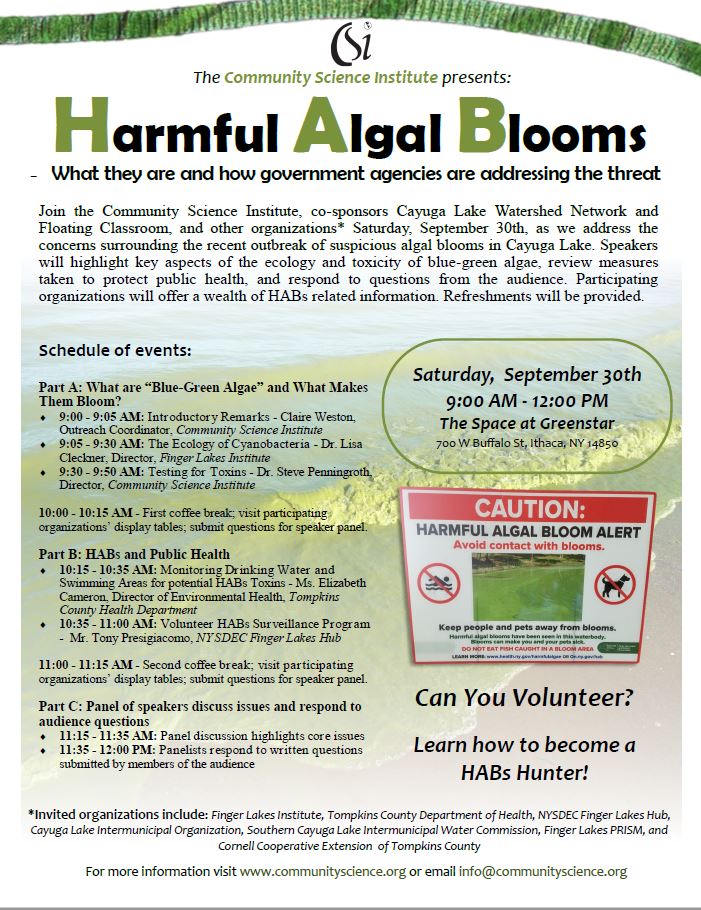
Harmful Algal Blooms: What they are and how government agencies are addressing the threat

On September 30, the Community Science Institute will be hosting a public forum on harmful algal blooms in Ithaca, New York. The Forum is co-sponsored by the Cayuga Lake Watershed Network and the
Floating Classroom.

The forum is designed to address public concerns and provide community members with information about the ecology of harmful algal blooms, how public health officials respond to such blooms, and future monitoring initiatives.

The event is scheduled to run from 9:00 to 12:00 pm at The Space at Greenstar, 700 W Buffalo St, Ithaca, NY 14850.

Invited organizations include: Finger Lakes Institute, Tompkins County Department of Health, NYSDEC Finger Lakes Hub, Cayuga Lake Intermunicipal Organization, Southern Cayuga Lake Intermunicipal Water Commission, Finger Lakes PRISM, and Cornell Cooperative Extension of Tompkins County.

For more on this event, click here.


Tuesday, September 5, 2017

Schuyler County Household Hazardous Waste, Electronics, and Tire Collection Day

Household Hazardous Waste, Electronics, and Tire Collection Day: Saturday, September 16th, 2017
REGISTRATION PERIOD: August 7 - September 13

WHERE: Schuyler County Highway Department, 901 S. Decatur Street, Watkins Glen

HOW TO REGISTER: Complete registration form and return to kvanhorn@co.schuyler.ny.us or mail to 105 Ninth Street, Unit 39, Watkins Glen, NY 14891.

CAN I REQUEST A DROP OFF TIME?: Yes! The drop-off times are assigned in 30 minutes increments starting at 9:00am. If you would like to come at a certain time please write that on your registration form and we will do our best to accommodate you.

Schuyler County and Yates County Residents Only (sorry, no businesses)

For more information, click here.

Tuesday, April 4, 2017

New freshwater fishing rules effective April 1

The state Department of Environmental Conservation has released multiple new freshwater fishing regulations that were effective April 1.

These changes are published in the 20176-2018 Freshwater Fishing Regulations Guide, in addition to being online on the DEC website.

According to the DEC, the changes are the result of a two-year process that included biological assessment, discussions with anglers and a formal 45-day comment period.

Monday, January 9, 2017

Second Chance for $3 Million in E-Waste Recycling Grants

DEC Announces Second Chance for $3 Million in E-Waste Recycling Grants:
New York State Department of Environmental Conservation (DEC) Commissioner Basil Seggos announced today that a second round of grant funding from the Environmental
Protection Fund (EPF) is being made available to help municipalities across the state address costs associated with the collection and recycling of eligible electronic wastes (e-waste). The recently completed application period in October generated $1.2 million in grant requests, leaving almost $1.8 million available for a second chance opportunity that will be held in January 2017 for municipalities that missed the initial application period. DEC will accept applications for second chance opportunity funding from January 2 through January 31, 2017.
Municipalities may receive reimbursement of up to 50 percent of eligible expenses incurred for recycling of e-waste between April 1, 2016 and March 31, 2017. Application materials, guidance documents, and important information for Electronic Waste Assistance Grants are available on the DEC's website.

Wednesday, March 16, 2016

Reminder: Residential brush burning is prohibited in NY through May 14

The Department of Environmental Conservation (DEC) reminds New Yorkers that with warming temperatures and dry conditions, residential brush burning in towns with less than 20,000 residents is prohibited from March 16 through May 14. With the lack of snow cover over much of the state and unseasonably warm temperatures forecasted, experts believe conditions for wild fires will be heightened in the coming weeks.

DEC posts a fire danger rating forecast map on a daily basis on its website.

Open burning of debris is the largest single cause of spring wildfires in the state. When temperatures are warmer and the past fall’s debris and leaves dry out, wildfires can start and spread easily and be further fueled by winds and a lack of green vegetation.

New York enacted strict restrictions on open burning in 2009 to help prevent wildfires and reduce emissions. The regulations allow residential brush fires in towns during most of the year, but prohibit such burning in spring when most wildfires occur. In the five-year period since the ban was enacted, the average number of spring fires per year decreased by 33.4 percent, from 3,297 in 2009 to 1,649 to 2015.

The DEC also urges citizens to employ alternatives to burning brush, like chipping wood and downed branches for use as mulch and composting yard waste, leaves and plant clippings for use in gardens.

Campfires using charcoal or untreated wood are allowed, but people should never leave fires unattended and must completely extinguish them before leaving the area. Burning garbage or leaves is prohibited year-round.

Some towns, primarily in and around the Adirondack Park and Catskill Park, are designated “fire towns,” and open burning is prohibited year-round in these municipalities unless an individual or group has a written permit from DEC. To find out whether a municipality is designated a “fire town” or to obtain a permit, contact the appropriate DEC regional office. A list of regional offices is available here.

Violators of the open burning state regulation are subject to both criminal and civil enforcement actions, with a minimum fine of $500 for a first offense.

Sunday, March 13, 2016

2016 Public Utility Law Institute | April 7, 2016

The New York State Bar Association will be sponsoring this full-day institute to stay up to date on current topics in public utility law.

Diane X. Burman, Department of Public Service Commissioner, is scheduled as keynote luncheon speaker.

The program will take place at the State Bar Center, One Elk Street, Albany, NY 12207. It is scheduled to run from 9:15am-4:05pm.

For more information, click here.

Monday, February 29, 2016

New York State to cover county and municipal e-waste recycling costs

The New York State Department of Environmental Conservation (DEC) has announced plans to reimburse counties for 50% of e-waste recycling costs up to $2 million per municipality:
Lawmakers heard that the state's 2010 e-waste law was fundamentally flawed because it vastly underestimated the amount of obsolete cathode ray tubes that people
would discard as they bought new flat screens. The problem, which first became apparent several years ago, got worse after January 2015 when state law banned the disposal of electronic waste in municipal landfills.

The law requires electronics manufacturers to support e-waste recycling only to specific annual weight-based goals determined by each manufacturer's current share of market sales. However, the heavy CRT tubes, which contain hazardous leaded glass, are much heavier than modern equipment and push weight totals of reclaimed material well above the recycling goals. By law the manufacturers are not responsible to pay for the excess.

CRTs have no recycling value and cost money to dispose of, so the financial burden is being shifted to local recycling programs. The problem could continue for years because there are still a lot of CRT tubes yet to be turned in....

The state is poised to partially fund local recycling programs to lessen the sting, said Eugene Leff, deputy commissioner of the Department of Environmental Conservation.

Monday, July 20, 2015

Grants Available for Local Drinking Water and Wastewater Improvements

The New York State Water Infrastructure Improvement Act provides $200 million in grant funding over three fiscal years, with $50 million in the first year and $75 million each year for the last two years.

This year, $30 million will be available for wastewater infrastructure projects and $20 million will be available for drinking water projects, which will be administered by the state Environmental Facilities Corporation, the state Department of Environmental Conservation and the state Department of Health.

Applicants seeking grant funding for wastewater projects are eligible to receive grants of either 25 percent of eligible project costs or $5 million, whichever is less.

Applications for both wastewater and drinking water projects are now available and due by September 4, 2015. More information on the grant program and applications is available here.

Wednesday, May 13, 2015

New York releases final fracking review, plans ban

Gannett News Service:
The state Department of Environmental Conservation released a final version of the roughly 2,000-page document, known as the Supplemental Generic Environmental Impact Statement or SGEIS, just after 4 p.m.

Now, DEC Commissioner Joseph Martens must wait at least 10 days before issuing a legally binding "findings statement," which he has said will formally put the state's fracking ban into place.

The complete report can be found here.

Monday, June 30, 2014

New York's high court says towns and villages can ban fracking

In a long-awaited decision, the New York State Court of Appeals has upheld the right of towns and villages in the State to ban natural gas drilling, sometimes referred to as "fracking."

Environmental groups are hailing the decision. Others warn that the bans may hurt job growth.

The complete decision is here.

Wednesday, May 21, 2014

Notice of Public Hearing, Proposed Local Law 2014-A, Town of Ovid

A public hearing will be held before the Town Board of the Town of Ovid, New York, at the Ovid Fire House, 2136 Brown St, Ovid, NY 14521 at 7:00 p.m. on the 11th day of June, 2014, concerning Proposed Local Law No. “A” of the year 2014: “Repealing Local Law No. 1, 2004 of the Town of Ovid,” which provides:
SECTION ONE: LEGISLATIVE INTENT

In 2004, the Town of Ovid enacted a Local Law No. 1 of the Year 2004, commonly referred to as the town’s “land use ordinance.” Rather than relate directly to the physical use of land, the utilization of land or the potential impact of a particular land use on neighboring properties, this local law provides for minimum lot sizes and setbacks for most properties within the town. It establishes a permitting process, to be overseen by the town clerk and it provides that the law will be enforced by an “enforcement officer” and “alternate enforcement officer,” each to be designated by the town board. The law also sets forth penalties for violations and an appeal process, with such appeals to be made to the town board and requiring a public hearing for each appeal.

A review of the history of this local law appears to suggest that practical and fiscal difficulties exist with the enforcement and administration of this local law.

Further, the Town of Ovid is concerned about uncertainties in the existing New York State tax cap law, including how expenditures mandated by law and expenditures and revenues controlled by the county and state interact with the tax cap, as well as increasing costs, such as unfunded mandates, over which the town’s control is limited. The Town is also concerned about Governor Cuomo’s proposal to implement a two-year freeze on property taxes in school districts and localities that stay within the two percent tax cap. The town board is accountable to prepare a responsible budget, which meets the Town’s obligations while minimizing the tax burden.

The town board is aware that the County of Seneca has adopted the following local laws which are in effect throughout the county and address various concerns related to building permits, land use and building safety:

Seneca County, Local Law No. 2 of the year 2006: “A local law providing for the administration and enforcement of the New York State Uniform Fire Prevention and Building Code and the State Energy Conservation Construction Code in the County of Seneca,” (Amended By Local Law No. 1-2008 & Local Law No. 1-2010);

Seneca County, Local Law No. 3 of the year 2012: “A local law to provide safe, stable, housing for recipients of public assistance within Seneca County;” and

These Seneca County Local Laws provide for administration and enforcement by county officials, through the offices of Seneca County Code Enforcement and Division of Human Services.

Based upon the foregoing, in order to minimize the tax and regulatory burden on town residents, and in light of existing regulations at the county level, it is currently the opinion of the town board that the “land use ordinance” appears to be unnecessary at this time and unduly burdensome on the town’s finances and operations.

Therefore, the town board proposes to repeal this local law while the town board and the town planning board continue its general study and review of new land use laws.

SECTION TWO: REPEALER

Local Law No. 1, 2004 of the Town of Ovid, commonly referred to as its “land use ordinance” is hereby repealed in its entirety.

SECTION THREE: EFFECTIVE DATE

This Local Law shall take effect immediately upon its filing with the Secretary of State of the State of New York in accordance with the Municipal Home Rule Act of the State of New York.

The complete text of the proposed local law is available here.