Wednesday, December 30, 2015

New York adopts new attorney discipline rules

From the New York State Office of Court Administration:
The new rules, which provide for a harmonized approach to the investigation, adjudication and post-proceeding administration of attorney disciplinary matters were approved following public comment and upon recommendation of the Administrative Board of the Courts. They will be promulgated as Part 1240 of the Rules of the Appellate Division (22 NYCRR Part 1240) and will take effect in July 2016.

The rules announced today are comprehensive in scope, and set forth a uniform approach to the full panoply of issues in attorney discipline, including: standards of jurisdiction and venue; appointment of disciplinary committees and staff; screening and investigation of complaints; proceedings before the Appellate Division; rules of discovery; the name and nature of available disciplinary sanctions and procedural remedies for further review; expanded options for diversion to monitoring programs; reinstatement; and confidentiality.

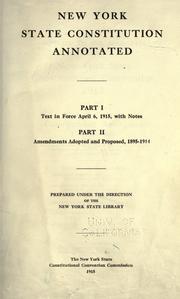
The new rules are available here.

Monday, December 21, 2015

New York State Constitutional Convention Boot Camp

In 2017, New York voters will decide whether to authorize a convention to consider revising the New York State Constitution. The New York State Bar Association co-sponsored a "boot camp" for reporters on the issue on Dec. 7.

While intended for journalists, the boot camp offers valuable information for everyone interested in the state constitutional process.

View a video of the boot camp here.

Thursday, December 17, 2015

Report: Gov. Cuomo vetoes transparency laws

Glens Falls Post-Star:
Gov. Andrew Cuomo over the weekend vetoed two laws intended to strengthen the Freedom of Information Law process but issued an executive order to expedite the process of receiving government documents, but only for state agencies.

Blair Horner, legislative director of New York Public Interest Research Group, said it is odd that Cuomo vetoed the measures when Robert Freeman, executive director of the State Committee on Open Government, recommended both measures in the state agency’s annual report...

Public interest advocacy groups and newspaper editorial boards advocated for both measures...

The Freedom of Information Law guarantees public access to government documents and records, with certain specific exceptions.

One of the bills the governor vetoed would have required state agencies to pay legal fees and court costs when a court rules that documents have been withheld without a reasonable basis...

The other bill Cuomo vetoed reduced the time public agencies have to appeal a court decision on access to public records — from nine months to two months.

Cuomo on Saturday issued an executive order that requires state agencies to file notice of an appeal, settle the record on the appeal and file a legal brief within 60 days.

Wednesday, December 2, 2015

Notice of Public Hearing: Town of Ovid Proposed Local Law No. E of the Year 2015

The Town Board will hold a public hearing at the Ovid Firehouse, 2136 Brown St Ovid, NY 14521, at 7:00 p.m. on the 9 day of December, 2015 in relation to Proposed Local Law No. E of the Year 2015, Town of Ovid, County of Seneca, State of New York: “A local law Repealing Local Law No. 2 of the year 2015."

The text of the proposed local as introduced is as follows:

Section 1. Local Law No. 2 of the Year 2015, “a local law to override the tax levy limit established in General Municipal Law §3-c,” which local law was duly passed by the Town Board on September 9, 2015, is hereby repealed in its entirety as unnecessary.

Section 2. This local law shall be effective upon its filing with the Secretary of State.

More more on the proposed local law, click here.

Monday, November 30, 2015

Michigan: How People Are Prosecuted For Breaking Laws They Don’t Know Exist

From Michigan Capitol Confidential:
Michigan has over 3,000 felonies and misdemeanors on the books — far more than the average resident could possibly remember. Obvious crimes, like murder or theft, make up some of these statutes, but more of them cover actions such as “transporting Christmas trees without a manifest” or burning grass clippings or leaves in certain areas.

These laws are especially dangerous to ordinary people because 26 percent of Michigan’s felonies and 59 percent of its misdemeanors don’t specify criminal intent. This means that people who never intended to break the law may be (and often are) prosecuted for crimes they had no idea they committed.

****

These reforms would not allow a Michigander to get out of a larceny charge by claiming ignorance of the law, but they would make it less likely for him to do jail time for catching a fish he didn’t realize was protected, or being smacked with hefty fines for failing to properly display a camping license on his tent.

Among the crimes that the average person might not realize exist are the following:
Lisa Snyder’s neighbors had children and early starts at work. She was happy to watch their kids until the school bus arrived in the morning — until she was threatened with penalties for running an unlicensed child care service.

Alan Taylor needed more parking at his growing business and thought he had received all the proper permits to expand the lot on his property. But the Michigan Department of Environmental Quality successfully prosecuted him for jeopardizing a wetland he didn’t know existed.

Kenneth Schumacher got rid of some scrap tires at what turned out to be an unlicensed disposal facility. Though he didn’t intend to break the law, he was sentenced to 270 days in jail and a fine of $10,000.

Michigan is not alone is this area. In 2009, it was estimated that many Americans unknowingly commit three felonies per day:
The average professional in this country wakes up in the morning, goes to work, comes home, eats dinner, and then goes to sleep, unaware that he or she has likely committed several federal crimes that day. Why? The answer lies in the very nature of modern federal criminal laws, which have exploded in number but also become impossibly broad and vague.

Friday, November 27, 2015

New York passes stricter DWI penalties

New legislation to reduce drunk driving among repeat violators through the use of ignition interlock devices (IID), has been signed into New York law.

The new law allows judges the discretion of extending the use of a mandatory interlock device when an individual has a high probability of repeatedly driving under the influence. Previously, the device could only be ordered for certain convictions of New York’s DWI laws.

An IID is an apparatus that is similar to a breathalyzer and is often attached to the ignition system of a motor vehicle as a condition of probation stemming from traffic-related infractions. The vehicle can only be started if the driver blows into the ignition interlock and his or her blood alcohol content (BAC) is below the legal limit of .08 BAC.

The measure was introduced by Republican New York State Senator Michael Nozzolio, and passed unanimously in both the Senate and Assembly.

For more information on the new law, click here.

Wednesday, November 25, 2015

Federal Court upholds local authority to regulate puppy mills

Municipal laws requiring pet stores in New York to obtain dogs and cats from certain licensed breeders and then sterilize the animals are not trumped by federal and state laws, a judge has decided.

The laws upheld were meant to guard against the sale of animals bred in inhumane conditions and then were sold to unsuspecting consumers. Through their sterilization rules, the laws also sought to address overpopulation of unwanted animals.

The ruling reinforces the ability of local governments to crack down on Amish and Mennonite puppy mills in New York State.

Tuesday, November 24, 2015

Consumer alert issued for Black Friday, Cyber Monday

In advance of the Christmas and holiday shopping season, New York State officials have the following tips for consumers shopping on Black Friday and Cyber Monday:
• Beware of misleading bargains and added fees.
• Compare warranty terms.
• Know the terms of a layaway plan.
• Check return and refund policies.
• Beware of restricted gift cards.
• Shop only on secure Internet connections.
• Do not be tricked by confusingly similar website and domain names.
• Protect yourself by using credit cards.
• Be wary of too-good-to-be-true contests and prize promotions.
• Read the fine print.
More on each of these tips can be found at the link above.

Tuesday, November 3, 2015

New York law expands court access for the hearing impaired.

The new law, which became effective Sept. 25, 2015, gives the courts authority, at the request of a person (party, witness, juror, or prospective juror) who is deaf or hard of hearing, to "provide an assistive listening device, a stenographer who can furnish communication access real-time translation or any other appropriate auxiliary aid or service."

For individuals with disabilities who need accommodations to assure accessibility to the courts, the New York State Court System's Accessibility page offers information about making accommodation requests and a list of Americans with Disabilities Act liaisons for each county. Information about the range of court interpretation services is available on the Court System's Language Access and Court Interpreters page.